Which institutions survive AI?
[prototype]As AI outcompetes people in the economy, culture, and politics, which mechanisms keep humans in control of the future?
Five toy scenarios. Composable defenses. Measured outcomes.
These are toy models — the smallest systems where each failure dynamic appears clearly. They produce candidate indicators, not measurements of the world.
The scenarios
Each scenario is a named way people lose influence over their future, drawn from the research literature. Each gets a minimal simulated environment where that failure unfolds by default — and where coordination mechanisms can be composed, run, and measured on how much influence they preserve.
- a person or organisation
- an AI system
- interaction
- a dynamic spreading
The Governed Commons
Ostrom, Governing the Commons (1990)
A community shares a renewable resource — a fishery. Every household sends an AI delegate to harvest on its behalf, and every delegate does what makes local sense — until the stock collapses under all of them. The oldest coordination failure there is, now with modern actors.
The dynamic
Individually rational harvesting outruns regeneration — unless the group can set and enforce its own rules.
In the Lab
A renewable stock with a regeneration rate, harvester agents with an AI delegate each, and rule proposals put to a vote. Run it with no governing mechanism and the fishery collapses; switch on quota voting or graduated sanctions and see whether it survives. This is the base scenario for trying out existing tools.
What we measure
- Resource stock remaining (%)
- Harvest-share inequality (Gini)
- Quota compliance rate
Defenses to try
- Harvest quotas set by group vote
- Graduated sanctions for rule-breaking
- Local monitoring
- Polycentric rule-making
Modelling assumptions
- One shared pool with logistic regrowth, harvested through fixed-behavior AI delegates. The key dial — delegate alignment — is a knob calibrated so the undefended baseline collapses, not a measured quantity. — leaves out: space, heterogeneous access rights, prices and trade
- Delegates never learn, so sanctions can confiscate but not deter. — leaves out: deterrence — that needs a learning delegate, tracked in the engine backlog
- Nobody talks: communication — the strongest measured fix in real commons experiments (Ostrom–Walker–Gardner 1992) — has no channel here.
Running today in the Collective Intelligence Library engine (fishing commons and governed harvest experiments); the only scenario with published benchmark scores so far.
Economic Disempowerment
Kulveit et al., Gradual Disempowerment §2 — Misaligned Economy
The economy serves human preferences because it depends on human labor and consumption. As AI substitutes for both, that dependence — and the alignment it quietly enforced — decays, even while output grows.
The dynamic
Human influence over what gets produced tracks how much the economy still needs people.
In the Lab
A civilization-world run of ~500 steps. Economic power is defined as processing power — agents produce, trade, and reinvest compute. Schedules set at the start introduce new actor types over time, including AI actors that reinvest faster than any human. You watch the competition spread node by node.
What we measure
- AI share of economic output (compute-weighted)
- Human labor share of income
- Market concentration (HHI)
Defenses to try
- Progressive taxation of AI-generated revenue
- Redistribution that preserves human purchasing power
- Subsidised human participation in key sectors
- Human ownership requirements
Modelling assumptions
- The whole economy is one CES production function; the substitutability dial decides everything, and with substitution high and reinvestment fixed, the collapse is assumed, not discovered. Successor substrates bracket that assumption instead of hard-coding it. — leaves out: any trade network — the economy is one equation
- There is no floor: the human income share is still sliding at tick 1500. The one scenario that collapses honestly.
- No buying: households only supply labor, so the consumption half of Gradual Disempowerment §2 cannot happen in this substrate. — leaves out: demand side, state actor
Cultural Disempowerment
Kulveit et al., Gradual Disempowerment §3 — Misaligned Culture
Culture evolves by variation and selection among the ideas people create and share. When AI-generated content replicates faster than human-originated content, cultural evolution continues — with people increasingly as its audience rather than its authors.
The dynamic
Higher replication fitness for AI-originated variants drives human-originated culture toward extinction.
In the Lab
A society’s values — say the liberal package: tolerance, free expression, rule of law — modeled as an epidemic spreading over a trust network. AI persuaders enter with rising persuasive power and seed competing variants; information warfare becomes a diffusion process you can watch. The question is not whether ideas spread — it is who originates the ones that win.
What we measure
- Share of prevalent values that are AI-originated
- Variant fidelity to origin intention
- Diffusion rate along the trust network
Defenses to try
- Provenance and watermarking
- Human-weighted curation mechanisms
- Understandability requirements on AI output
- Institutions that privilege human origination
Modelling assumptions
- Culture is tracked by origin only — human- vs AI-originated — as a two-sided contagion on a network drawn once and frozen. — leaves out: what the ideas actually say (content and dissonance belong to a planned sibling model), rewiring, media structure, population turnover
- The non-collapse floor is one slider: native reversion, a constant that keeps firing however small the native community gets. Zero it in the playground and displacement runs to completion — we checked (share 0.59 → 0.008).
- Reversion is load-bearing: without it, universal AI culture is the only fixed point and pluralism cannot exist.
Political Disempowerment
Kulveit et al., Gradual Disempowerment §4 — Misaligned States
Influence over collective decisions has always been unevenly spread — but it stayed contestable, because power ran through people, and people push back. When AI amplifies some actors’ reach a thousandfold, influence concentrates into fewer hands faster than any institution rebalances it.
The dynamic
Power concentration is measurable — and in the undefended baseline, the concentration curve bends only one way.
In the Lab
A network of actors exchanging influence — citizens, organisations, a state that answers to whoever sustains it. AI amplification is handed to a few nodes on a schedule, and the influence distribution is measured every step. The open question, straight from the paper: can we see concentration early enough to act?
What we measure
- Influence concentration (Gini / HHI) over time
- Network centralization index
- State responsiveness lag
Defenses to try
- Faster, more representative democratic processes
- AI delegates that advocate for citizens with high fidelity
- Citizen assemblies and sortition
- Revenue structures that keep states dependent on people
Modelling assumptions
- A polity is one listening matrix; influence is its leading eigenvector (Golub–Jackson), and citizens stay partially anchored to their own signal (Friedkin–Johnsen) — the anchor keeps amplified worlds distinguishable. — leaves out: parties, elections, representation, a state actor
- The floor is baked in: AI actors never stop listening to citizens, so the human share stops near 0.46 however hard the sliders push — swept and insensitive; no dial removes it.
- This scenario measures who gets heard — voice, not the state. Gradual Disempowerment §4 is about tax base, coercion, and legitimacy; that substrate does not exist here yet.
Backend landed 2026-07-27 (influence_exchange, 8-rung validation ladder incl. the Golub–Jackson eigenvector anchor); benchmark scores land on the leaderboard below.
The Combined System
Kulveit et al., Gradual Disempowerment §5 — Mutual Reinforcement
Economic power buys cultural influence; cultural influence shapes politics; political power rewrites economic rules. Each domain can look stable on its own while the coupled system drifts somewhere nobody chose — and cannot drift back.
The dynamic
Domains that are each recoverable alone can lock in jointly — and a defense that wins in one domain can lose once the domains are coupled.
In the Lab
All three environments — the compute economy, the value epidemic, the influence network — running simultaneously, coupled: economic power buys persuasion, persuasion shifts politics, politics rewrites market rules, and the flywheel closes as captured rules pay rents to AI capital and converted humans buy AI services. Mechanisms that pass each domain’s benchmark run again here, together.
What we measure
- Cross-domain coupling strength
- Correlated-decline index across domains
- Defense transfer gap (single-domain vs combined score)
Defenses to try
- Portfolios of the mechanisms above, measured together rather than alone
- Cross-domain monitoring
- Stress tests against burdens shifting between domains
Modelling assumptions
- Composition, not a new model: the three substrates’ own equations run interleaved in one state over one shared population — every sibling card’s assumptions are inherited verbatim, floors included.
- Five couplings, one dial κ — money buys reach, culture directs attention, influence writes the rules, captured rules pay rents to AI capital, converted humans buy AI services — all exactly neutral at κ = 0, so every run has a sealed same-seed twin. — leaves out: measured coupling strengths — gains are hand-set; only sign and ordering claims are robust
- A loop plus two rent channels, not the paper’s full mesh — and nothing here is a basin: everything is a rate or a level, so irreversibility itself is not yet modeled. The spectral lock-in conjecture stays an unverified research thread, not a finding.
Backend landed 2026-07-27 (coupled_society, five κ-gated couplings): transfer gap 0.128 defended / 0.109 undefended at defaults — the defended gap is larger, the sharpest form of the paper’s claim. Benchmark scores land on the leaderboard below.
How the Lab works
Every scenario above is an instance of the same pipeline: compose a world, schedule mechanisms as processes over time, run it, read the system’s properties. These are the working design sketches of the interface we’re building.
Compose the world
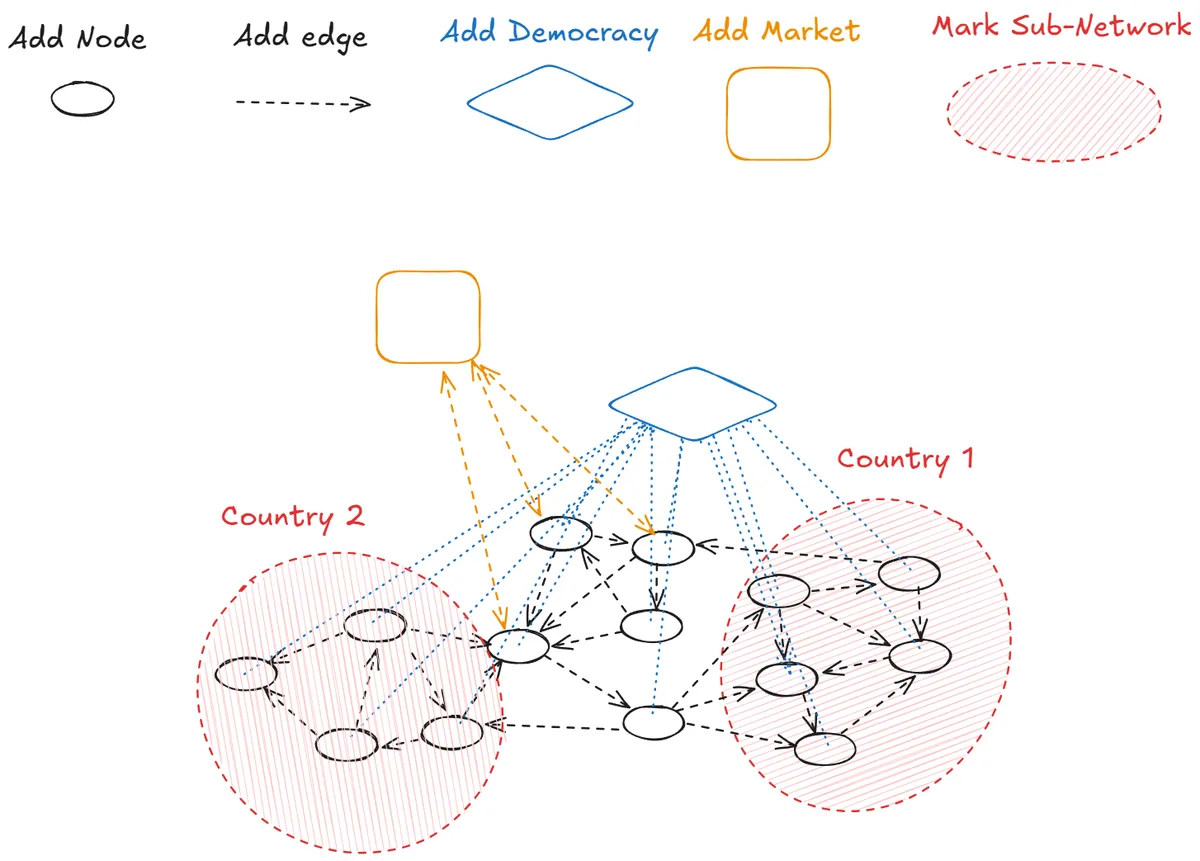
Agents, relationships, and mechanisms are all first-class objects in a graph editor. Drop in a democracy, wire up a market, mark a sub-network as a country or a regulator.
Schedule the mechanisms
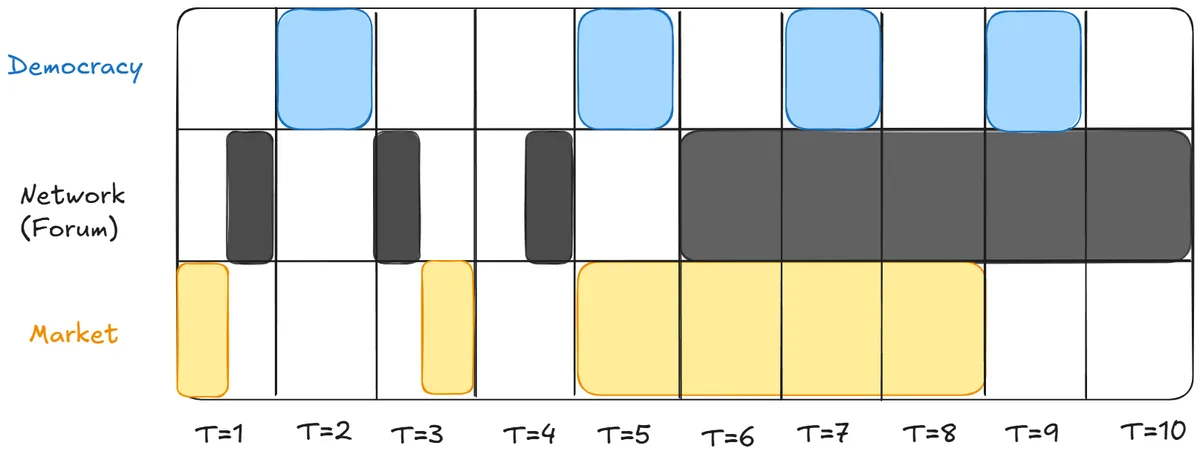
Mechanisms are processes, not fixtures. A schedule says when each one runs — a vote every fourth step, a market open all quarter — and the schedule itself can change as the run unfolds.
Run the simulation
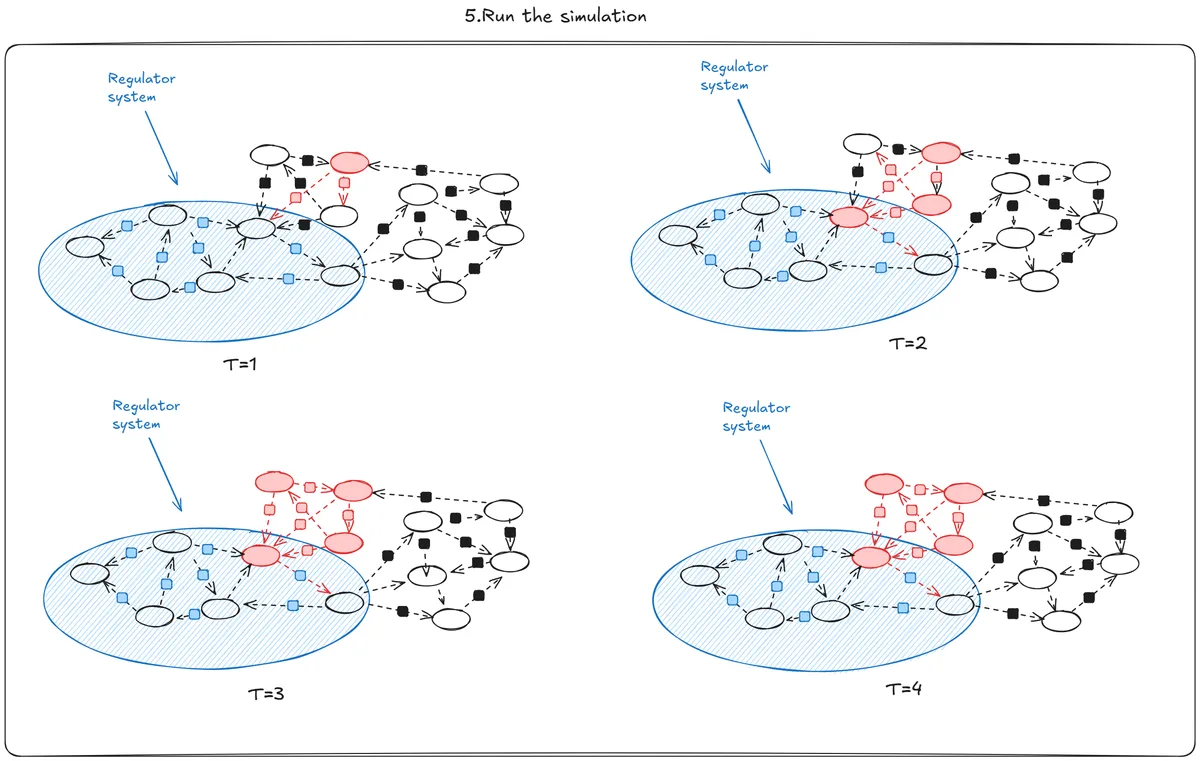
Hundreds of steps of message passing, trust updates, and spreading dynamics. Sub-networks like a regulator system hold part of the graph while contagion tests the rest.
Visualise and measure
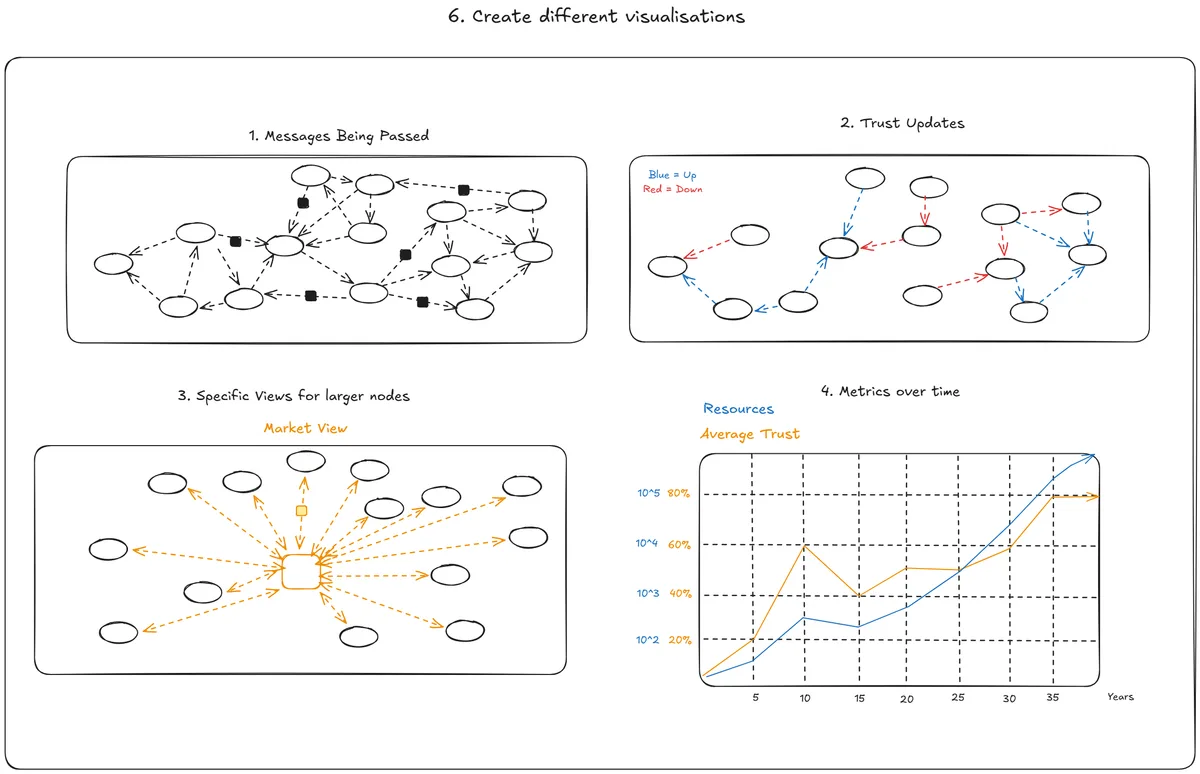
Every run can be seen from any angle: messages being passed, trust rising and falling edge by edge, per-mechanism views like the market’s own network, and metrics over time — the influence and concentration curves the scenarios above are built to bend.
Design sketches, not screenshots — the interface is in development. The engine underneath runs today.
What the leaderboard will measure
IllustrativeIllustrative data. Only the Governed Commons has produced real runs so far; real benchmark results land here as scenarios go live.
| Mechanism | Commons | Economic | Cultural | Political | Combined |
|---|---|---|---|---|---|
| Quota voting | 0.81 | — | — | — | 0.44 |
| Progressive AI taxation | — | 0.72 | — | — | 0.38 |
| Human-weighted curation | — | — | 0.66 | — | 0.41 |
| Liquid democracy | — | — | — | 0.68 | 0.31 |
| Conditional prediction markets | — | 0.61 | — | 0.55 | 0.47 |
Read the last column: defenses that score well in a single domain tend to score worse when domains couple. That gap is the finding the Lab is built to measure.
Build a defense
The Lab is open source: preset environments, composable mechanisms, shared metrics. Design a mechanism, run it against a scenario, and see how much influence it preserves. If you have an idea about how groups should decide, this is the wind tunnel.